

Why does that "instant online offer" for your car often feel like it vanishes the moment you pull onto a dealership lot? It's a frustrating gap that leaves many Canadian drivers feeling more than a bit anxious about the car appraisal process. You've likely spent time researching your vehicle's worth, only to worry that a hidden mechanical issue or a shift in the local market might suddenly devalue your pride and joy. We believe this transition should feel like the start of an exciting new journey, not a high-pressure negotiation battle.
By mastering the internal logic of professional valuations, you can step into your next trade-in with total confidence and ensure you receive the maximum fair market value. This guide provides a transparent look at the specific metrics used by experts in 2026, including how the current 14.5% annual depreciation trend impacts your vehicle. We'll walk through exactly how to prepare your car, what documents you need for a smooth transition, and how to turn a complex transaction into a simple, rewarding partnership.
Key Takeaways
- Understand how a professional evaluation of your vehicle’s condition translates into real trade-in equity for your next journey.
- Navigate the five essential steps of the car appraisal process, from recording your VIN to a thorough interior and exterior assessment.
- Discover the power of market data, including how Carfax Canada reports and local supply trends shape your final offer.
- Learn why specific engineering from Japanese and German brands can lead to higher residual values during an appraisal.
- Master the "Detailing Dividend" and other simple preparation steps to ensure your vehicle makes the best possible first impression.
What is a Car Appraisal and Why is it Essential?
A professional car appraisal is a formal evaluation of your vehicle’s mechanical health, cosmetic condition, and current market worth. Think of it as a detailed health check for your car that translates directly into financial power for your next purchase. While many people start their journey with a quick search, the actual car appraisal process is a collaborative effort between you and a local expert to find the most accurate value for your trade-in. This step is vital because it establishes the exact equity you can apply toward your next pre-owned sedan or SUV.
When you understand exactly how your car is being judged, the anxiety of the dealership environment begins to fade. Transparency is the cornerstone of this interaction. A clear, line-by-line breakdown of why your vehicle is valued at a certain price builds a foundation of trust. This clarity ensures that when you transition into your next vehicle, you do so knowing your equity is based on facts rather than guesswork. A professional appraisal is the only way to turn a "maybe" into a guaranteed financial figure.
The Difference Between Market Value and Trade-In Value
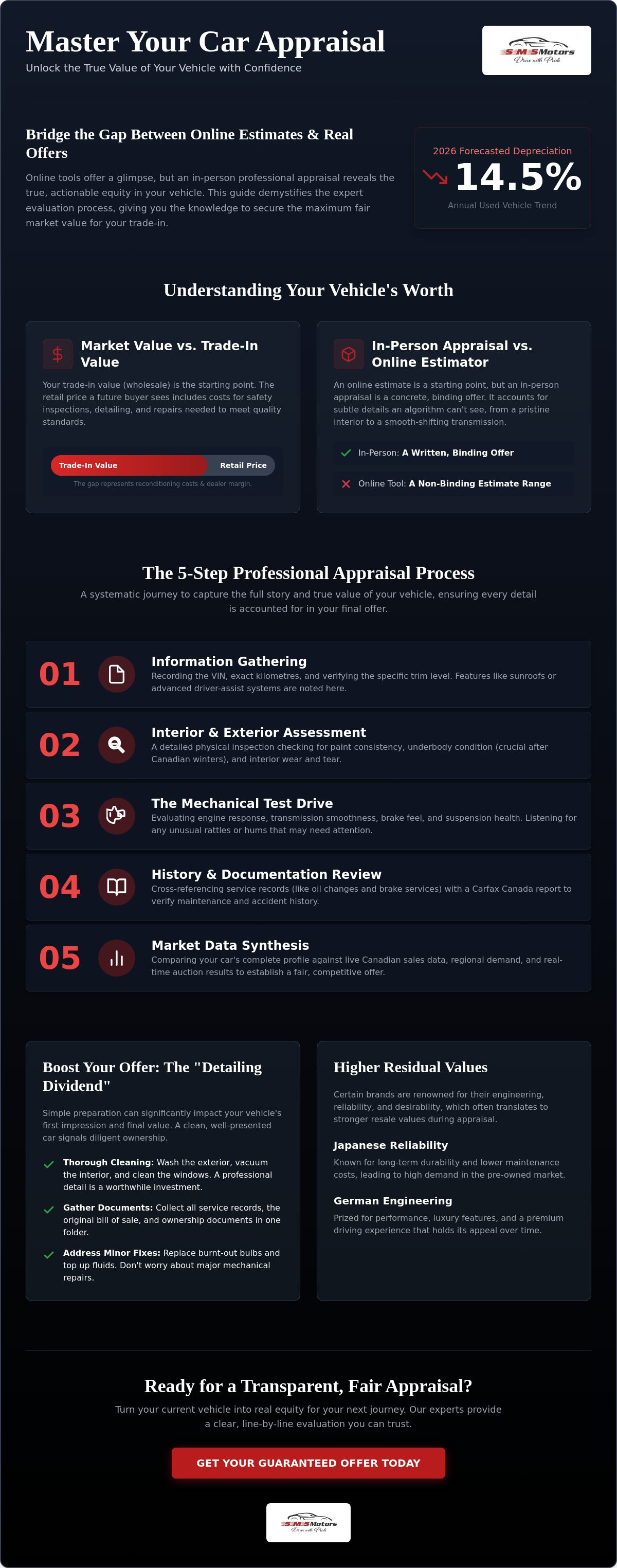
It is helpful to understand that Car valuation involves two distinct numbers: wholesale and retail. Wholesale pricing represents what a dealership pays to acquire inventory, while retail is the price a future buyer might see on the lot. The difference between these two numbers often accounts for reconditioning costs. These are the investments made for safety inspections, professional detailing, and mechanical repairs to ensure the vehicle meets high quality standards. In the Canadian market, value is a moving target influenced by real-time auction data and regional demand. With used vehicle depreciation forecasted at 14.5% for 2026, having an expert who understands these shifts is essential for receiving a fair and competitive offer.
Why an In-Person Appraisal Trumps Online Estimators
Online estimators provide a ballpark figure, but they have significant blind spots. An algorithm cannot detect the subtle scent of a well-maintained interior or the smooth shift of a transmission during a test drive. These physical nuances are what truly define a car's worth. A physical inspection allows a professional to verify previous repairs and identify mechanical excellence that a VIN decoder simply misses. Most importantly, a professional, in-person car appraisal process results in a written, binding offer. This is far more valuable than a non-binding online range. It gives you a concrete number to use when planning your budget and exploring your financing options with confidence.
The 5-Step Professional Appraisal Process
The car appraisal process is far more than a quick glance at your odometer. It's a systematic, five-step journey designed to capture the full story of your vehicle. By following a structured approach, appraisers ensure that every unique feature and maintenance effort is accounted for in your final offer. This transparency helps you understand exactly how the dealership arrives at a competitive figure for your trade-in.
Step 1: Information Gathering. This begins with recording the Vehicle Identification Number (VIN) and exact kilometres. The appraiser also verifies your specific trim level, as features like a panoramic sunroof or advanced driver-assist systems can significantly boost value. Step 2: Exterior and Interior Assessment. This is a detailed physical inspection. While dealerships use this to determine trade-in equity, a vehicle appraisal may also be required for tax purposes in some Canadian provinces if you opt for a private sale.
Step 3: The Mechanical Test Drive. A professional takes the wheel to evaluate engine response, transmission smoothness, and suspension health. They listen for rattles or hums that might indicate future maintenance needs. Step 4: History and Documentation Review. Here, service records and accident history are cross-referenced. Having a complete folder of oil changes and brake services proves you've cared for the vehicle. Step 5: Market Data Synthesis. Finally, the appraiser compares your car's condition against live Canadian sales data to arrive at a fair, competitive figure.
The Exterior Walkaround: What Appraisers Look For
Canadian winters are notoriously tough on cars. Appraisers specifically check for underbody rust or salt corrosion that can hide beneath the surface. They also examine paint consistency across panels to detect previous, unreported bodywork. Even smaller details matter. Curbed wheels or low tire tread depth are noted, as these are common reconditioning costs for a dealership. If you have aftermarket modifications, keep in mind they often lower the value unless they're high-demand, factory-approved additions.
The Interior and Electronics Check
Inside the cabin, the focus shifts to functionality and comfort. Appraisers test everything from the climate control to the latest safety sensors. They use OBD-II scanners to check for "stored codes" in the car's computer, which can reveal electronic faults that haven't triggered a dashboard light yet. Persistent odours or upholstery tears are also evaluated. If you're curious about how your car's tech stacks up, you can always explore our vehicle trade-in services for a detailed professional opinion during your next car appraisal process.
The Data Behind the Offer: History and Market Trends
Professional appraisers don't just look at the car; they look at the data. The car appraisal process relies heavily on digital history reports and real-time market metrics to ensure the final number is grounded in reality. Carfax Canada is the primary tool for this investigation. It reveals previous insurance claims, active liens, and even detailed service history. If a vehicle has "Title Branding"-such as being labelled salvage, rebuilt, or having flood damage-its resale potential and safety profile change significantly. Modern appraisal software now tracks live auction results and retail transactions across the country, allowing for a valuation that reflects exactly what Canadian buyers are paying right now.
This data-driven approach ensures that your offer isn't just a guess; it's a reflection of the broader automotive landscape. By combining physical findings with national trends, we create a transparent valuation. This helps you feel confident that you're receiving a fair price based on the most current information available in 2026. Following National Appraisal Guidelines ensures that every evaluation remains consistent and professional.
Deciphering the Carfax Canada Report
A Carfax report is a vehicle’s resume. Interestingly, a clean, consistent service history can sometimes outweigh minor cosmetic blemishes like small stone chips. Appraisers look for regular oil changes and scheduled maintenance as proof of a well-cared-for machine. However, unfixed safety recalls can temporarily lower an appraisal or even pause the car appraisal process until the work is completed at a certified service centre. We also pay close attention to provincial registration history. A car that has moved through multiple provinces might trigger red flags regarding varying inspection standards or history gaps. This level of detail protects both the dealership and the future owner.
How Economic Factors Influence Your Offer
Regional demand is a powerful driver of value. In Canada, fuel prices directly impact whether buyers are hunting for efficient sedans or spacious SUVs. Seasonality also plays a major role. Appraising an all-wheel-drive SUV in the autumn often results in a higher offer because dealerships need that inventory for winter shoppers. Conversely, a convertible might see more interest in the early spring. Supply and demand aren't static; for example, the supply of used vehicles aged 0-8 years is expected to decrease by 2.6% in 2026, which helps support the value of late-model trade-ins. High interest rates currently slow the velocity of the used car market by increasing the total cost of financing for the next buyer.
Specialized Appraisals: Japanese Reliability and German Luxury
A Toyota Corolla and a Mercedes-Benz S-Class might both be four-door sedans, but they inhabit completely different worlds during the car appraisal process. Appraisers recognize that different brands have different value drivers. For some, it's the promise of reaching 300,000 kilometres with only basic maintenance. For others, it's the prestige of cutting-edge technology and premium materials. Recognizing these brand-specific strengths allows us to provide a more tailored and accurate valuation that reflects the true desirability of your vehicle in the Canadian market.
Understanding these nuances helps you navigate the car appraisal process with realistic expectations. Whether you're trading in a "bulletproof" commuter or a high-performance luxury machine, the goal is to identify the specific features that make your car stand out to the next buyer. If you're ready to see how your brand's reputation impacts your bottom line, you can get a professional trade-in value from our expert team today.
Appraising Japanese Sedans and SUVs
Japanese brands like Toyota and Hyundai often command higher-than-average residual values because of their reputation for mechanical longevity. In the current Canadian economy, fuel-efficient Japanese commuters are in incredibly high demand. Appraisers focus heavily on the health of the powertrain, knowing that a well-maintained Japanese engine is often just getting started at 100,000 kilometres. This "bulletproof" reputation means these vehicles often retain value much better than their domestic counterparts, especially when they have a clean service history. We look for signs that the car has been used for its intended purpose: reliable, daily transportation.
The Nuances of German Luxury Valuations
Valuing a BMW, Audi, or Mercedes-Benz requires a different set of eyes. For these vehicles, optional equipment and "packages" have a massive impact on the final offer. A base model and a fully loaded version of the same German sedan can have vastly different appraisals. We also prioritize the "Maintenance Premium." Documented specialist servicing, such as "Service B" records for a Mercedes, is vital for a top-tier offer. German cars are precision machines, so appraisers specifically check for brand-specific wear items like air suspension bags or timing belt intervals. A luxury car with a complete, specialist-stamped logbook will always command a higher price because it offers the next owner peace of mind regarding future repair costs.
Curb appeal also plays a bigger role in the luxury sector. We assess the condition of premium materials like Nappa leather and real wood trim, as these define the luxury experience. A German vehicle that looks and feels showroom-ready will always perform better during an appraisal than one with visible interior wear, regardless of what the odometer says.
Maximizing Your Value: How to Prepare for an Appraisal
Starting the car appraisal process with a well-prepared vehicle is the easiest way to ensure you receive a top-tier offer. While the appraiser focuses on mechanical data, your preparation signals how much you've valued the car during your ownership. Start by gathering every set of keys and fobs. A missing modern key fob can cost hundreds of dollars to replace; providing both sets immediately increases the car's "ready-to-sell" status. Don't forget the owner’s manuals in the glovebox. These small details prove complete ownership and a high level of attention to detail.
A clean car suggests a well-maintained engine. This "Detailing Dividend" isn't just about vanity. When an appraiser sees a pristine interior and a washed exterior, they naturally associate that care with the mechanical components they can't see. Address small, low-cost repairs before the professional arrives. Replacing a burnt-out headlight bulb or a cracked wiper blade costs very little. However, it prevents the appraiser from wondering what other maintenance might have been neglected over the years. This proactive approach builds immediate trust and sets a positive tone for the entire valuation.
To simplify your preparation and capitalize on this "Detailing Dividend," you can visit Suds Detailing for professional mobile services that ensure your vehicle makes a stellar first impression.
The Documentation Checklist
Organizing your service history into a chronological folder can add significant value to your offer. This physical proof of oil changes, brake services, and spark plug replacements removes the "risk factor" for the dealership. Ensure you have the vehicle’s registration and any warranty transfer papers ready to go. If you've recently invested in major maintenance, like a new set of tires or a fresh brake job, keep those receipts on top. These recent investments directly reduce the reconditioning costs the dealership must factor in, often resulting in a higher final number for your trade-in.
Final Steps: Accepting the Offer
In Canada, trading in your vehicle toward a pre-owned sedan or SUV offers a unique "Tax Savings" benefit. You only pay sales tax on the price difference between your trade-in and your next vehicle. This can save you thousands of dollars compared to a private sale where you would pay tax on the full purchase price of your next car. Once the car appraisal process is complete, the offer typically remains valid for a specific window, such as 7 days or 500 kilometres. This gives you the breathing room to make a decision with confidence and ease. Ready to see what your car is worth? Book a professional appraisal with SMS Motors today.
Step Into Your Next Chapter with Confidence
Mastering the car appraisal process turns what used to be a source of anxiety into a powerful tool for your next vehicle purchase. You now understand that a fair offer isn't just a random number; it's a careful synthesis of your car's physical condition, its unique service history, and live Canadian market data. Whether you're bringing in a reliable Japanese sedan or a precision-engineered German SUV, your preparation and documentation are the keys to unlocking the best possible trade-in equity.
At SMS Motors, we pride ourselves on being a VSA Licensed Dealer #40588 that specializes in the very Japanese and German inventory you drive. Our team is dedicated to a transparent, data-backed valuation process that prioritizes your peace of mind over high-pressure tactics. We believe that selling your car should feel like the beginning of an exciting new journey rather than a stressful transaction. Our goal is to ensure you feel supported at every step of the way.
Start your hassle-free trade-in journey with an SMS Motors appraisal and experience a partnership built on trust and local expertise. We look forward to helping you transition into your next vehicle with total ease and excitement.
Frequently Asked Questions
How long does a professional car appraisal take?
A professional car appraisal usually takes between 30 and 45 minutes to complete. This time allows the appraiser to perform a thorough physical inspection, conduct a mechanical test drive, and cross-reference your vehicle's history with current market data. We aim to make this part of the car appraisal process as efficient as possible so you can spend more time exploring your next pre-owned sedan or SUV without feeling rushed.
Does a car appraisal cost money at a dealership?
Most dealerships provide trade-in appraisals at no cost to the customer. This is a complimentary service designed to help you understand your equity before you commit to a new journey. It is helpful to distinguish this from specialized appraisals required by the government for tax purposes on private sales, which typically carry a professional fee. We believe in providing this information freely to build a foundation of trust and partnership.
Will an accident on my Carfax report ruin my car’s value?
An accident on your Carfax report won't necessarily ruin your car's value, but it will influence the final offer. Appraisers look at the severity of the incident and the quality of the repairs performed. A minor insurance claim for a scratched bumper is quite common in Canada and has a much smaller impact than major structural damage. We focus on the current safety and reliability of the vehicle to ensure you get a fair deal.
Should I fix the dents and scratches before getting an appraisal?
You usually shouldn't spend significant money on bodywork before an appraisal. Dealerships have access to wholesale repair rates, meaning they can fix dents and scratches more affordably than a private owner can. Unless it is a very simple fix like a light polish or a burnt-out bulb, you likely won't see a dollar-for-dollar return on your investment. We recommend focusing on a deep clean to make a great first impression instead.
Can I get an appraisal if I still owe money on my car loan?
Yes, you can absolutely start the car appraisal process even if you still have an active loan on your vehicle. The appraiser will determine the car's current market value, and the dealership will help you calculate the equity by subtracting your remaining loan balance. If your car is worth more than you owe, that positive equity serves as a great down payment. We specialize in finding financial solutions for various ownership situations.
Why is the dealer’s appraisal lower than the Black Book or Kelley Blue Book value?
Online guides provide a broad average based on national data, while a dealer offer reflects the specific condition and local demand for your car. A physical appraisal accounts for the exact wear, tear, and reconditioning costs needed to meet safety standards. It also considers how many similar models are currently sitting on lots in your specific region. This localized approach ensures your offer is grounded in real-time market reality.
How long is a dealership’s appraisal offer valid for?
Most professional appraisal offers remain valid for 7 days or 500 kilometres, whichever comes first. This window is designed to give you the breathing room to make an informed decision without feeling pressured. Because the Canadian used car market can shift due to auction trends and supply changes, these offers do have an expiry date. We want you to feel confident and excited about your transition into a different vehicle.
Does having winter tires included increase the appraisal value?
Including a second set of winter tires and wheels definitely adds value to your appraisal. In the Canadian climate, winter tires are a high-demand item that the next owner will likely need to purchase anyway. Providing them with the car increases the vehicle's desirability and resale potential on the lot. It is a great way to maximize your trade-in equity while ensuring the next driver starts their journey safely and with peace of mind.