Did you know that used vehicle inventory across Canada jumped by more than 21 per cent heading into the summer of 2026? While this shift gives you more negotiating power, finding the right used cars still feels like a high-stakes balancing act between price and peace of mind. You might find yourself caught between the legendary reliability of a Japanese sedan and the refined performance of a German SUV, all while wondering if your credit score will stand in the way of a fair deal.
We believe that buying a vehicle should be the start of an exciting new journey, not a source of stress. This guide will help you compare vehicle categories and brands so you can find the perfect match for your lifestyle and budget. We'll walk through the essential inspection steps to ensure you avoid hidden histories and explain how to secure financing that works for your specific situation. By the end of this article, you'll have a clear plan to drive home a reliable vehicle with total confidence.
Key Takeaways
- Discover why 2026 is a strategic time to buy and how to leverage the depreciation advantage to get the most features for your budget.
- Compare the long-term reliability of Japanese engineering against the luxury and precision of German brands to see which matches your driving style.
- Evaluate the practical trade-offs between sedans and SUVs, including fuel efficiency and the importance of All-Wheel Drive for Canadian winters.
- Master a professional five-step checklist for inspecting used cars to identify hidden history or mechanical issues before you sign.
- Learn how to navigate financing and trade-in options with confidence, ensuring your monthly payments align perfectly with your lifestyle goals.
The Value Proposition: Why Used Cars Make Financial Sense in 2026
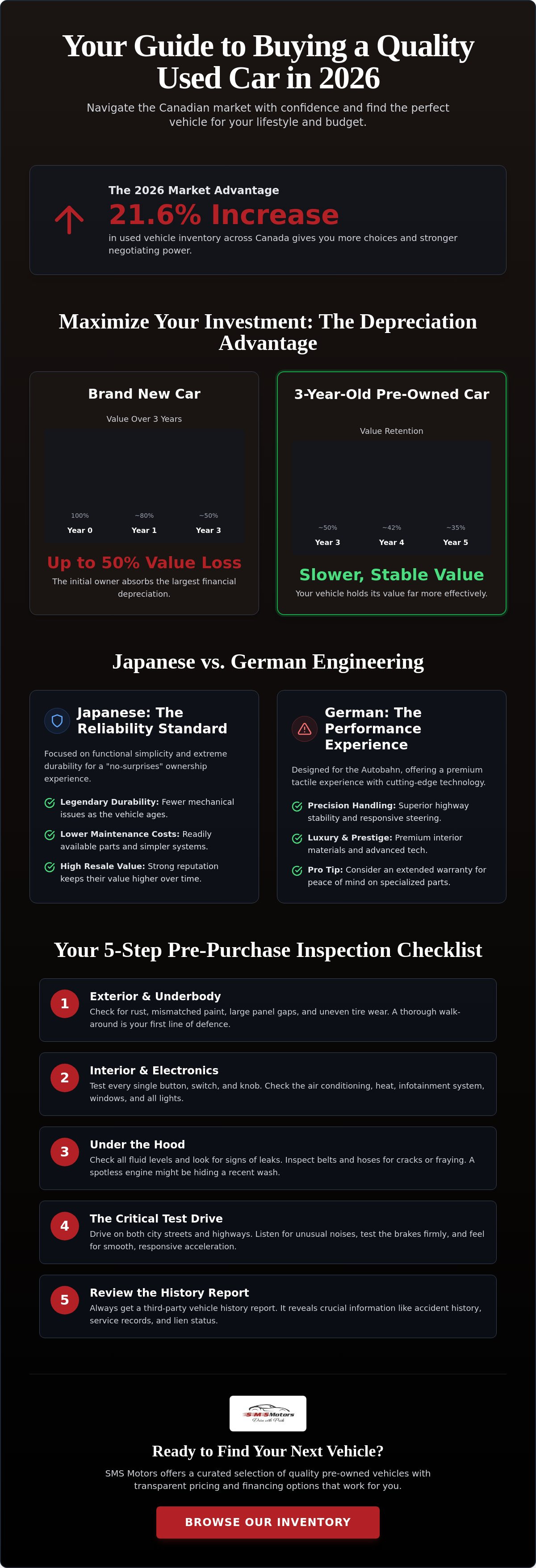
The 2026 market has reached a fascinating turning point for Canadian drivers. After several years of tight supply and aggressive bidding, used car inventory has surged by 21.6 per cent in recent months. This shift moves the power back into your hands. Choosing used cars today isn't just about saving a few dollars at the dealership; it's about maximizing the value of every dollar you spend. Modern vehicles are engineered with such precision that a car with 100,000 kilometres on the odometer is often just entering its prime. You get a vehicle that has proven its durability while avoiding the high costs associated with a brand-new model.
One of the most compelling reasons to go pre-owned is the "Depreciation Advantage." A new vehicle typically loses about 20 per cent of its value the moment it leaves the lot. By the time it's three years old, that drop can reach 40 or 50 per cent. When you buy a vehicle at this stage, the previous owner has already absorbed that massive financial hit. You enjoy a modern, tech-heavy car that retains its remaining value much more effectively. This stability is a key component of the global used vehicle industry, where savvy buyers prioritize long-term equity over the temporary novelty of a new registration.
Beyond the sticker price, used vehicles offer hidden savings through insurance and registration. In many provinces, insurance premiums are notably lower for older models because the replacement cost is lower. Additionally, while you should always check your local provincial tax rates, the lower purchase price naturally reduces the total tax burden. It's a logical, efficient way to get on the road without unnecessary overhead.
Comparing New vs. Pre-Owned Costs
When you look at the total cost of ownership over five years, the savings are significant. Financing for used cars has become incredibly competitive, with prime rates starting around 7.26 per cent. Because you are financing a smaller principal amount than a new car, your monthly payments remain manageable. This allows you to benefit from recent technology cycles, such as advanced infotainment and driver-assist features, without paying the "early adopter" premium found on the latest releases.
The Lifestyle Fit: More Car for Your Dollar
Choosing a pre-owned vehicle allows you to upgrade your entire daily experience. Instead of settling for a base-model economy car with basic features, your budget might allow for a premium Japanese sedan or a luxury German SUV. You gain access to advanced safety systems and superior interior materials that would be financially out of reach in a new model. This flexibility means you don't have to choose between a reliable commute and a vehicle you actually enjoy driving. You can have both while keeping your financial goals on track.
Japanese vs. German Engineering: Comparing the Giants
Choosing between a Japanese or German vehicle is more than just a brand choice. It's a choice between two distinct engineering philosophies. For Canadian drivers, this decision often dictates how much time you'll spend at the mechanic versus how much you'll enjoy your time on the highway. While both regions produce exceptional used cars, they prioritize different aspects of the ownership experience to meet different lifestyle needs.
Reliability and Resale: The Japanese Edge
Japanese brands like Toyota and Hyundai have mastered the art of the "no-surprises" vehicle. Their engineering philosophy focuses on functional simplicity and extreme durability. This approach leads to fewer mechanical surprises as the vehicle ages. For a buyer, this translates to lower maintenance costs and a higher resale value when it's time to trade in. When you're looking at a high-mileage Japanese sedan, pay close attention to the service records. Even a reliable Toyota needs regular oil changes and brake inspections to reach that 300,000-kilometre mark with ease.
Performance and Prestige: The German Experience
German engineering, represented by titans like BMW and Mercedes-Benz, offers a completely different tactile experience. These vehicles are designed for the Autobahn; they provide a level of highway stability and steering precision that is hard to match. The interior luxury is often years ahead of the competition, featuring premium materials and advanced infotainment systems that still feel modern today. These complex systems do require specialized care. If you're considering a pre-owned luxury model, an extended warranty is a brilliant way to protect yourself from the higher cost of European parts. It allows you to enjoy the prestige and performance without the anxiety of unexpected repair bills.
Maintenance expectations vary significantly between the two groups. Japanese parts are widely available at almost every local shop in Canada, which keeps routine repair bills manageable. German cars often require specific fluids and diagnostic tools that are more common at specialized service centres. If you aren't sure which engineering style fits your daily routine, you can explore our current inventory to compare these driving dynamics side by side. Whether you want the rugged reliability of a dedicated commuter or the refined power of a performance sedan, understanding these roots helps you make a choice that fits your long-term budget. Buying a vehicle is the start of a new journey; picking the right engineering philosophy ensures it's a smooth one.
Sedans vs. SUVs: Choosing the Right Body Style
Deciding between a sleek sedan and a robust SUV is often the first major hurdle for anyone browsing used cars in Canada. It isn't just about the look of the vehicle; it's about how that vehicle integrates into your daily life. While SUVs have dominated the market recently, the humble sedan remains a formidable contender for those who prioritize efficiency and a connected driving experience. The right choice depends on your specific balance of passenger comfort, cargo needs, and the realities of our varied climate.
One of the most significant factors in Canada is All-Wheel Drive (AWD). In the past, if you wanted AWD, you were almost forced into an SUV. Modern engineering has changed that. Many pre-owned sedans from both Japanese and German manufacturers now feature sophisticated AWD systems that handle icy suburban streets with ease. However, if your winter commute involves unplowed backroads or clearing high snowbanks at the end of your driveway, the extra ground clearance of an SUV becomes a practical necessity rather than a luxury.
Urban manoeuvrability is another area where the two styles diverge. If you spend most of your time in the centre of a busy city, a sedan offers a clear advantage. They are easier to parallel park in tight spots and feel more agile when navigating narrow parking garages. Conversely, if your weekends involve hauling hockey bags, camping gear, or making trips to the local home improvement store, the vertical cargo space and towing capacity of an SUV provide a level of versatility that a trunk simply cannot match.
The Case for the Pre-Owned Sedan
Sedans are the champions of fuel economy. For long-distance commuters, the aerodynamic profile and lower weight translate to significant savings at the pump. Beyond the numbers, sedans offer a "fun to drive" factor that SUVs often lack. Because they have a lower centre of gravity, they feel more planted during cornering and provide better feedback through the steering wheel. This makes a daily commute feel less like a chore and more like an engaging experience.
The Versatility of the Pre-Owned SUV
The primary draw of an SUV is the commanding view of the road. Sitting higher up provides better visibility in heavy traffic, which many drivers find reassuring. Modern SUVs have also made massive strides in closing the fuel efficiency gap, with many four-cylinder and hybrid options performing nearly as well as their smaller counterparts. The interior flexibility is the real winner here. With seats that fold flat and plenty of headroom, an SUV adapts to your lifestyle as it changes, whether you're adding a new family member or picking up a gear-heavy hobby.
The 5-Step Comparison Checklist for Used Car Buyers
Buying a vehicle should be a highlight of your year, not a source of stress. When you are comparing used cars, having a logical system in place helps you filter out the noise and focus on quality. This 5-step checklist is designed to move you from initial curiosity to a confident purchase with total transparency. By following these steps, you ensure that the car you choose today will remain a reliable partner for years to come.
Decoding the Vehicle History Report
Your first step is always the Carfax report. This document is the biography of the vehicle, detailing every major event from its first registration. When you see "minor damage" listed, don't immediately walk away. This often refers to cosmetic repairs, such as a bumper scuff or a small dent from a parking lot. While it doesn't affect the safety of the car, it will lower the future resale value. You should use this data to ensure the price reflects the vehicle's true history. Look for consistent service intervals at a certified centre; a car that has received regular oil changes and fluid flushes is far more likely to be a dependable choice than one with long gaps in its maintenance record.
Pay close attention to where the car has lived. A vehicle from a province with harsh winters and heavy road salt might show more undercarriage wear than one from a milder climate. If the report shows the car has moved through multiple owners in a short period, it's worth asking why. Consistency is king when it comes to long-term reliability, and working with a professional team like Nas-Motive Auto Sales & Services LTD ensures that your vehicle receives the regular attention it needs to perform safely on Canadian roads.
After the paperwork, move to a visual inspection in bright daylight. Look for colour mismatches between body panels, as this often indicates previous paint work that might not be on the history report. Check the tyres for uneven wear. If the inside edge of a tyre is more worn than the outside, the car likely has alignment or suspension issues. These are small clues that tell a much larger story about how the previous owner treated the vehicle.
Mastering the Test Drive
The test drive is your best opportunity to feel how the car performs in the real world. Start by turning off the radio. You need to hear the engine's natural rhythm and listen for any unusual clicks or whirs. Drive the car on both quiet city streets and at highway speeds. This allows you to test the transmission smoothness during gear changes and the responsiveness of the steering at higher velocities. If the steering wheel vibrates at 100 kilometres per hour, the wheels might just need balancing, or it could point to more significant mechanical needs.
Test the brakes firmly in a safe area to check for pulsing or pulling to one side. Once you're back at the lot, verify every electronic feature. In Canada, working heated seats and a powerful defrost system are essential for comfort. Check the safety tech, the infotainment screen, and even the power windows. Finally, review the financing and warranty options. With prime rates for used cars typically starting around 7.26 per cent, finding a plan that fits your monthly budget is the final piece of the puzzle. If you want to see how these steps work in practice, you can browse our current inventory of thoroughly inspected vehicles to find your next match.
SMS Motors: Your Partner in Finding a Quality Used Car
Finding the right vehicle is only half the journey; finding the right dealership is the other. At SMS Motors, we've built our reputation on being more than just a car lot. We see ourselves as a helpful partner in your next chapter. Our inventory is carefully curated to focus on premium Japanese and German brands because we know these manufacturers provide the best long-term value for Canadian drivers. Whether you are looking for the fuel-efficient simplicity of a Toyota or the refined precision of a BMW, our goal is to ensure you drive away in a vehicle that matches your lifestyle and your high standards for reliability.
The car-buying process should be filled with optimism and excitement rather than pressure. We maintain a transparent environment where you can explore our used cars at your own pace. Our team acts as a friendly guide, providing the expert data you need to make an informed decision without the high-pressure tactics that often define the industry. We believe that a satisfied customer is one who feels confident in their purchase, which is why every vehicle in our centre undergoes rigorous quality checks before it ever reaches the lot.
A Solution-Oriented Approach to Financing
We understand that financial backgrounds are as diverse as the drivers we serve. Our finance department takes a solution-oriented approach to help you realize your goal of ownership, regardless of your credit history. By working with a wide network of partnered financial institutions, we can offer flexible credit options that fit your monthly budget. The process is designed to be efficient and inclusive, often allowing for same-day approvals so you can start your new journey without delay. Choosing a reliable pre-owned vehicle is also a practical way to rebuild your credit, as consistent, manageable payments demonstrate financial stability over time.
The SMS Motors Promise
Our commitment to you extends far beyond the moment you sign the paperwork. We offer a variety of protection packages and extended warranties designed to provide long-term peace of mind. These solutions are tailored to protect your investment from the unexpected, ensuring that your ownership experience remains as smooth as the day you drove off the lot. If you have a current vehicle, our trade-in process is designed to be straightforward and fair. We provide a clear market value for your car, which can then be applied directly to your next purchase to make it even more affordable. We invite you to browse our current inventory of sedans and SUVs today! Your next great driving experience is waiting for you, and we're here to help you find it.
Drive Home with Total Peace of Mind
You now have a clear framework to navigate the Canadian market with absolute clarity. By understanding the unique strengths of Japanese and German engineering and following a disciplined inspection checklist, you've turned a complex process into a manageable journey. Choosing between a fuel-efficient sedan or a versatile SUV is no longer a guessing game; it's a strategic decision based on your specific lifestyle needs and long-term budget goals.
At SMS Motors, VSA Dealer Number 40588, we're proud to be your local expert in premium used cars. We combine our deep expertise in Japanese and German inventory with a commitment to inclusive, flexible financing for all credit types. Our team is dedicated to providing a transparent, pressure-free experience that prioritizes your satisfaction above all else. We're ready to help you find a vehicle that you'll love driving every single day.
Find your next reliable used car at SMS Motors
We look forward to welcoming you to our dealership and helping you start your next exciting chapter on the road with confidence.
Frequently Asked Questions
Is it better to buy a used car from a dealer or a private seller?
Buying from a dealership is generally the better choice because it provides a level of security and convenience that private sales cannot match. When you choose a professional dealer, you gain access to certified inspections, extended warranties, and flexible financing options. Private sales are "as-is" transactions, meaning you have little recourse if a mechanical issue appears shortly after the purchase. Dealerships also handle the complex provincial registration paperwork for you, ensuring a smooth and legal transition.
What is a good mileage for a used car in 2026?
A good mileage for a vehicle in 2026 is typically between 15,000 and 20,000 kilometres for every year it has been on the road. For example, a three-year-old car with 50,000 kilometres is considered to be in excellent condition. Modern engineering means that many used cars can easily surpass 200,000 kilometres with proper care, so don't be afraid of a slightly higher number if the service history is impeccable and documented.
How does financing a used car differ from a new one?
Financing for pre-owned vehicles typically involves slightly higher interest rates than new car loans, but the total amount borrowed is significantly lower. For prime borrowers in 2026, interest rates for used cars often start around 7.26 per cent. Because the purchase price is lower, your monthly payments are often more affordable than those for a new model. This allows you to pay off the vehicle faster and build equity sooner, which is a significant financial advantage.
Should I buy an extended warranty for a used German luxury car?
Purchasing an extended warranty for a pre-owned German luxury vehicle is a very smart financial move. These cars feature sophisticated electronics and precision performance components that can be expensive to repair out of pocket. A warranty acts as a safety net, allowing you to enjoy the prestige and performance of a BMW or Mercedes-Benz without worrying about unexpected costs. It's an investment in your peace of mind and the long-term health of the vehicle.
What are the most reliable used car brands in Canada?
Toyota, Honda, and Hyundai consistently rank as the most reliable brands for Canadian drivers due to their durable engines and excellent cold-weather performance. These manufacturers focus on engineering simplicity, which leads to fewer mechanical failures as the vehicle ages. German brands like BMW and Mercedes-Benz are also highly reliable when maintained correctly, offering superior safety features and highway stability that many drivers prefer for long-distance travel across the provinces.
Can I trade in my car if I still owe money on the loan?
You can definitely trade in a vehicle even if you still owe money on your current auto loan. The dealership will evaluate your car's market value and use that amount to pay off your existing balance with the lender. If your car is worth more than you owe, that positive equity becomes a down payment for your next purchase. If you owe more than the car's current value, the difference can often be rolled into your new financing plan.
What documents do I need to bring to the dealership to buy a used car?
To ensure a quick and easy purchase, you should bring your valid Canadian driver's license, proof of active auto insurance, and a recent pay stub for financing verification. If you are trading in a vehicle, remember to bring the ownership registration and all sets of keys. Having these documents ready allows the dealership to finalize your paperwork efficiently and often lets you drive away in your new vehicle the same day.
How can I check if a used car has been in an accident?
The most reliable way to check a vehicle's accident history is by reviewing a comprehensive Carfax report. This report lists insurance claims, police reports, and repair records tied specifically to the vehicle's unique VIN. You should also conduct a visual inspection for inconsistent paint colours or uneven gaps between body panels. These physical signs often point to previous bodywork or repairs that might not have been officially reported to insurance companies.